The Handfasting Knot: Custom, Symbol and Later Imagination
The handfasting knot has several meanings, not one fixed Irish origin. Learn how to distinguish historical terminology from modern ritual choices and claims.
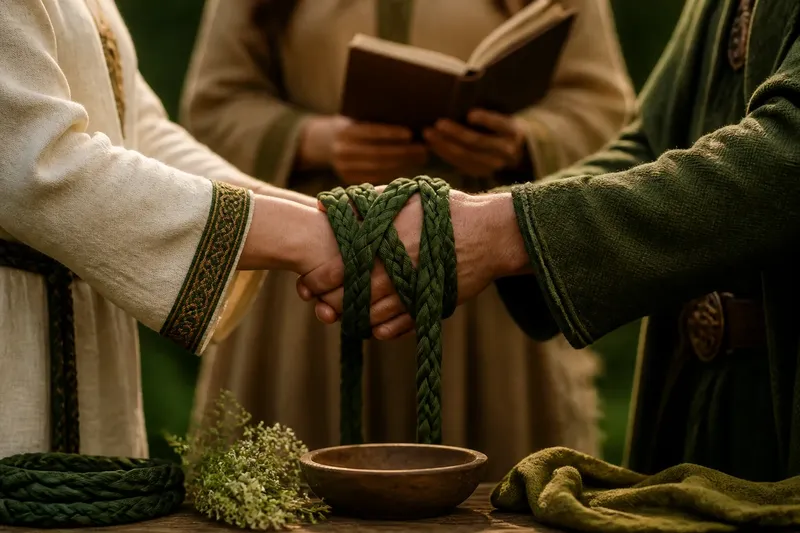
The most common mistake about the handfasting knot is treating it as proof of one ancient Irish wedding ceremony, complete with a fixed script and standard knot. That can cost readers a clear view of what the evidence actually describes: a binding gesture, a relationship term, or a modern symbolic choice. Handfasting’s meanings need to be read in their historical and local context.
Handfasting is often described as binding a couple’s hands with a cord or cloth. The gesture is easy to picture, but its interpretation depends on the account. Separate the act from claims about its age, legal force and supposed uniformity.
The binding gesture
In its simplest form, handfasting involves placing or binding the couple’s hands together. A cord may lie over the hands, pass around them or be arranged in a knot. These details do not, on their own, show that every community followed one prescribed rite.
The image of joined hands can suggest a public promise, a union acknowledged by witnesses, or two people choosing to share a life. Those readings explain the gesture’s appeal, but symbolism alone cannot establish what it meant in every place or period.
Nor does the word “knot” settle the matter. A cord may be looped without forming a lasting knot, while a knot may serve as an emblem rather than a practical fastening. The phrase can gather several related gestures under one memorable name.
Reading historical records
Different kinds of sources answer different questions. A local description may record a custom; a legal text may address the status of a union; and a later account may explain a cord’s symbolism. They should not be treated as interchangeable evidence.
For example, a record discussing a temporary or conditional union would not, by itself, prove that couples performed the same hand-binding ceremony. Conversely, a description of hands being bound would not establish that the act created a legally recognised marriage. The meaning depends on the source’s date, purpose, terminology and the people it describes.
When reading a claim, ask who recorded it and whether the source describes a ceremony, a legal arrangement or a later interpretation. Broad statements about all Irish couples or all ancient weddings need evidence broad enough to support them. Local custom and general legal language should not be blended without explanation.
Marriage and legal status
Historical references to “handfasting” do not always use the term in the same way. Some discuss marriage or a promise of marriage. Other accounts associate it with a temporary arrangement, but that interpretation should be tied to the particular source rather than presented as a settled definition applying across Ireland.
This distinction matters because a ritual’s emotional or communal force is not the same as its legal effect. A couple might understand a binding gesture as a solemn vow, while a court or governing authority might assess their union under different rules. Hands being tied does not, by itself, establish the legal status of the relationship.
Historical legal questions require care because rules and their application changed across time and place. For present-day marriage or legal questions, consult the relevant registrar or a qualified legal professional rather than relying on folklore terminology.
Modern ritual choices
Contemporary descriptions sometimes present handfasting as a complete ancient ceremony with a standard cord, a fixed number of turns and a definitive knot. These can be meaningful choices in a present-day ritual, but they should not be described as universal historical requirements unless a suitable source supports that claim.
Say a couple wants to include handfasting and has read that one knot was used by every Irish bride. They choose a soft woven ribbon, ask a friend to place it over their joined hands, and explain that it represents their shared promise. Guests see the binding gesture, while the couple avoids presenting their chosen knot as a recovered national rule.
Couples can choose a ribbon or cord for comfort and appearance, and decide who places it and when it is removed. What is not worth the effort is searching for one supposedly authentic knot pattern that must apply to every Irish ceremony. If a couple wants to draw on a family or local tradition, they can ask relatives or knowledgeable community members what they recognise without treating one person as a spokesperson for everyone.
Questions about handfasting?
Is handfasting uniquely Irish?
No. Hand-binding customs and historical uses of the term are not confined to one modern national identity. An Irish connection may matter in a particular account or family tradition, but it does not make every practice exclusively Irish.
Does the knot make a marriage legal?
Not by itself. A symbolic binding and legal recognition are separate matters, and present-day requirements depend on the relevant jurisdiction and ceremony. Ask a registrar or qualified legal professional about legal status.
Must a handfasting use a particular cord?
No single cord or knot should be presented as compulsory for every use. In a modern ceremony, people can choose a material and arrangement that suit their intentions, while making clear that these are their choices.
Can handfasting be part of a modern wedding?
Yes, couples may include handfasting as a symbolic part of a ceremony. They can explain its personal meaning without claiming that their version reproduces one uniform ancient rite.
The handfasting knot is best understood as both a gesture and an interpretation: hands are bound, and people explain what that binding means. Keeping those layers distinct allows the custom to remain meaningful while leaving historical claims open to the evidence behind them.