The Claddagh Ring Is Not a Universal Love Code
Claddagh ring meanings draw on familiar symbols, but wearers interpret them differently. Learn how to understand the design without assuming someone’s status.
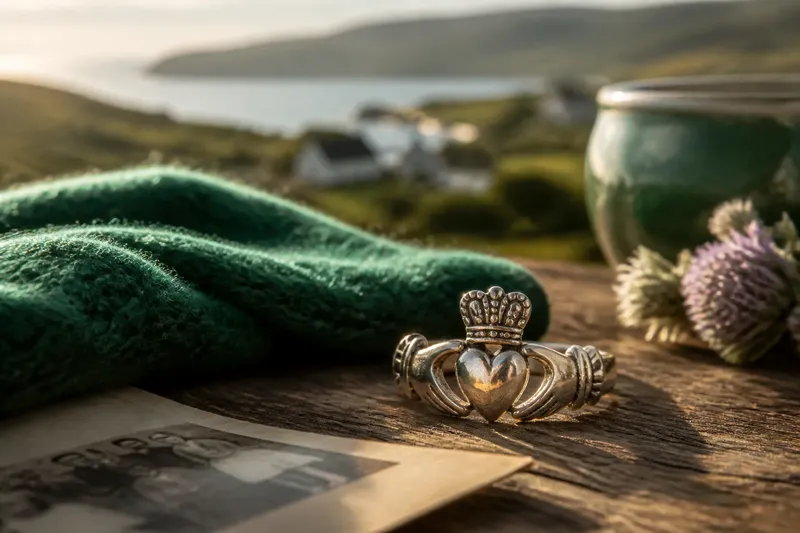
The common mistake with Claddagh ring meanings is treating the ring as a fixed relationship signal: a heart, hands and crown supposedly announce one clear answer about the wearer. That shortcut can turn a personal heirloom or gift into an awkward assumption, because the familiar design does not impose one rule on everyone.
The ring is strongly associated with Irish identity and affection, but its meaning comes from people as well as its imagery. In commonly circulated interpretations, the hands represent friendship, the heart represents love and the crown represents loyalty. These associations are a familiar way to explain the design, not a universal codebook or an official rule for every wearer.
Symbol and signal
A symbol gathers meaning through repeated use. A signal, by contrast, is meant to communicate a relatively definite message to someone who recognises it. The Claddagh can function as either, but no one looking at a ring can know which role its owner has chosen.
This distinction matters because popular explanations often attach relationship status to how the ring is worn, including which hand it is on or which way the heart faces. Such conventions are widely repeated, yet they are not a dependable way to read every wearer. A person may follow one convention, another family’s custom, or none at all.
The design itself also allows different emphases. One person may value the heart as a sign of romantic love; another may focus on friendship, loyalty, Irish heritage or a connection to someone who gave the ring. These meanings can coexist, change over time or remain private.
Where readings go wrong
Confusion often starts when a familiar explanation is mistaken for an official instruction. A shop description, gift-card message or online diagram may present a wearing pattern as if it settles the question for every ring owner. The explanation may reflect a common tradition, but repetition does not make it binding.
A second problem arises when observers assume the ring must be announcing a current relationship. It might instead be a family keepsake, a present from a friend, a piece chosen for its Irish associations, or simply jewellery the wearer likes. The visible object cannot tell you which explanation applies.
There can also be a mismatch between giver and recipient. A giver may intend a romantic message while the recipient understands the ring as a mark of friendship or heritage. The ring has not failed; the people have attached different meanings to the same object, so a considerate conversation is more reliable than trying to decode it from a distance.
Reading the ring respectfully
- Observation: You can see the hands, heart and crown. If you want to describe the design, name those elements; then mention their commonly circulated associations as possibilities. If you need to know what the wearer means, ask rather than infer.
- Observation: A guide links the ring’s position or heart direction to relationship status. If you are discussing that guide, present it as a convention some people follow; otherwise, do not use it to label the wearer.
- Observation: The ring looks like a family keepsake or gift, but its history is unknown. If the wearer shares its story, follow their account; if not, leave its history open rather than inventing one.
- Observation: The ring’s meaning matters to a conversation you are having. If the moment is appropriate, ask, “Does your Claddagh ring have a particular story for you?” If the wearer changes the subject or declines, let the question go.
- Observation: The wearer gives a personal explanation that differs from a diagram or shop description. If they say it is a family custom or a friendship gift, accept that as the meaning of their ring; otherwise, do not correct them with a generic account.
- Observation: Someone wears a Claddagh without explaining it. If no conversation calls for a question, treat it as jewellery with a meaning you do not know; if you do ask and receive no answer, respect their privacy.
Say you notice a Claddagh on a colleague’s hand and remember a guide that links its position to relationship status. You decide not to infer anything from the orientation; when a suitable conversation arises, you ask whether the ring has a story. Your colleague says it belonged to a relative and is worn in their memory, so the resulting understanding concerns that particular object rather than an assumed relationship status.
Questions about Claddagh meanings?
What do the hands, heart and crown mean?
Commonly circulated interpretations associate the hands with friendship, the heart with love and the crown with loyalty. These are familiar explanations of the design, while an individual wearer may give the elements a different or more personal emphasis.
Does the way a Claddagh ring is worn prove relationship status?
No single wearing pattern proves the wearer’s status. Accounts of hand and heart orientation circulate as conventions, but people may use them differently or ignore them, so a ring is not a reliable substitute for asking respectfully.
Can a Claddagh ring be worn for reasons other than romance?
Yes. Someone may wear one for friendship, family remembrance, Irish heritage, a gift’s meaning or appreciation of the design. Romantic associations are familiar, but they do not exclude these other reasons.
Is there one correct meaning for an inherited ring?
The design has common associations, while an inherited ring may carry a particular family story that matters more to its owner. If that story is unknown, leave room for uncertainty rather than inventing one.
What the ring carries
Objects used across generations can collect meanings without losing their recognisable form. The Claddagh’s heart, hands and crown make it legible as a symbol of connection, while a wearer’s choices and relationships supply details that the design cannot contain by itself.
That is why the ring can be culturally familiar without functioning as a universal love code. Its commonly circulated symbolism can help explain why someone chose it, but the person wearing it remains the best source for its particular meaning. If no explanation is offered, the respectful reading is simply that the ring matters to its wearer in a way you may not know.
It is not worth memorising every claimed hand-and-heart arrangement in the hope of reading strangers accurately. Keep the familiar symbolism in mind, ask only when the conversation makes it appropriate, and let a personal meaning remain personal when it is not shared.