Irish Place Names: What a Familiar Element Can Tell You
Read Irish place names more carefully by checking each element against a specialist source, then separate a plausible clue from an unproven local history.
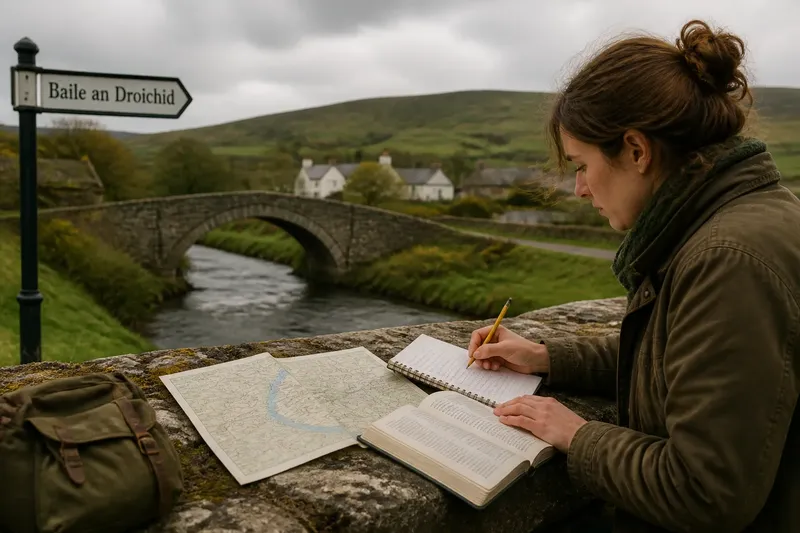
The common mistake with Irish place names is to treat one recognisable element as a complete translation. Spotting baile or cill can suggest a settlement or church association, but it does not explain exactly how a place got its name; the shortcut can turn a clue into an invented history. Read the full form, check uncertain words in a reliable Irish-language or place-name source, and keep interpretation separate from proof.
A name on a map
Say you are planning a fictional walk through the invented village of Baile an Droichid, “the settlement of the bridge”. You have a paper map, a notebook and an Irish dictionary, but no local history. Your aim is to notice what the name may suggest, not to reconstruct the village’s past.
Begin with the complete Irish form, then check each element and its grammatical form in a specialist place-name resource. For this invented example, suppose a qualified source confirms the intended reading as “settlement of the bridge”. That reading suggests an association; it does not establish that a bridge still stands, when one was built, or which crossing the name refers to.
Names can preserve older spellings and sounds, and Irish and English forms may differ. A dictionary entry that does not match a form on a map is a reason to check the grammar and the full name, not to force a translation from the nearest-looking word.
Settlement elements
Baile is a familiar element in Irish names, but its precise sense in a particular name should be checked rather than assumed. It may be associated with a settlement or named territorial area; the form alone does not tell you the place’s age, size or present status.
Cluain and ráth are also worth checking in context. A dictionary or place-name entry may help establish whether an element points towards a landscape description or an enclosure, but a suggested meaning does not show that a corresponding feature remains visible today.
Keep the clues distinct. A settlement term, a landscape term and a word associated with an enclosure raise different questions. None, by itself, identifies who lived there or what happened.
Church and landscape clues
Cill is commonly associated with a church or church site in Irish names, while coill is associated with wood or woodland. Check the exact form and the place-name context before settling on a gloss. Even a well-supported word meaning does not prove that a building or woodland survives at the spot shown on a modern map.
Gleann and cnoc are often glossed as “valley” and “hill” respectively, but a specialist source can clarify how each functions in a particular name. A landform may be named from a local viewpoint, and the present landscape may not preserve the feature as it once appeared.
Use a map, local records or a heritage source to look for context, while keeping each source’s limits in view. A visible feature can make a reading plausible, but matching a word to a feature is not proof of the name’s origin.
Grammar and full forms
Irish names can contain changed word forms and connecting words that affect how the elements relate. In the invented name Baile an Droichid, the intended bridge relationship depends on reading the complete phrase, not translating baile or droichid in isolation. Confirm the intended interpretation through a reliable Irish-language or specialist place-name reference.
Compare the official Irish form, English form and locally used name where these are available. They can preserve different naming habits or stages, but spelling differences alone do not settle a name’s history. Record uncertainty rather than treating one version as an automatic explanation of the others.
Checking Irish place names?
Does baile always mean a town?
No single English gloss should be applied automatically to every name. Check a specialist entry for the particular form and read it as part of the whole name.
Can a name prove a feature is still there?
No. A name may preserve an older description or association even after the landscape has changed. A map or local record can help investigate the possibility, but neither a word nor a present-day match proves the feature’s history.
Why do Irish and English forms differ?
Forms may reflect different spellings, pronunciations or naming practices. Compare them with a specialist resource rather than assuming that one spelling provides a complete history.
Where should I check a doubtful translation?
Start with a reliable Irish dictionary and a specialist place-name resource, checking the complete form and its grammar. For heritage work where the distinction matters, ask a knowledgeable local or Irish-language specialist.
A worked bridge reading
Imagine you have a fictional map labelled “Baile an Droichid”, a notebook and access to a specialist place-name entry. First, you copy the complete Irish name and note that the map also gives an English form. Next, the specialist entry confirms, for this invented example, the intended reading “settlement of the bridge”. You write that as the source-supported interpretation, not as an independently established history.
Then you inspect the map and see a river crossing near the named area. That makes a bridge association plausible, but it does not show that the present crossing is the one meant. If the map shows no bridge instead, you record that the feature is not visible there; the name’s interpretation remains, while the location and history of any bridge remain unresolved.
The result is a clear distinction: the specialist source supports a reading of the wording, and the map offers limited present-day context. An old map or local record might answer a further question, but until then the unanswered detail should stay unanswered.
Useful checks and decisions
- Check whether you have copied the complete Irish form; if you have, look up the whole name, but if you have only a fragment, return to the map or sign and record the full form first.
- Check whether a specialist entry gives the same word form and grammatical context; if it does, note its interpretation, but if it does not, mark the gloss uncertain and consult an Irish-language specialist.
- Check whether the source distinguishes a word’s general meaning from its meaning in this name; if it does, record both separately, but if it does not, avoid presenting the general gloss as the place-name translation.
- Check whether the Irish and English forms are both available; if they are, compare them, but if one is missing, do not infer the absent form from the other.
- Check whether a map or record shows a feature that fits the proposed reading; if it does, call the fit plausible, but if it does not, leave the feature’s location and survival unresolved.
- Check whether your notes distinguish source-supported interpretation from observed evidence; if they do, share the reading with those limits, but if they do not, revise the notes before presenting a local history claim.
What not to chase
It is not worth trying to extract a dramatic story from every syllable or match every word to a feature on a modern map. That effort can create false certainty, especially when the name’s grammar or history is unclear. A brief note separating “source-supported meaning”, “possible clue” and “unconfirmed detail” is more useful than a polished translation that hides its gaps.
When reading Irish place names, check the full form against a reliable specialist source, then state what the wording supports and what remains uncertain. That small distinction lets you share a useful interpretation without turning a linguistic clue into an unsupported account of the past.